 Scholar Nurse
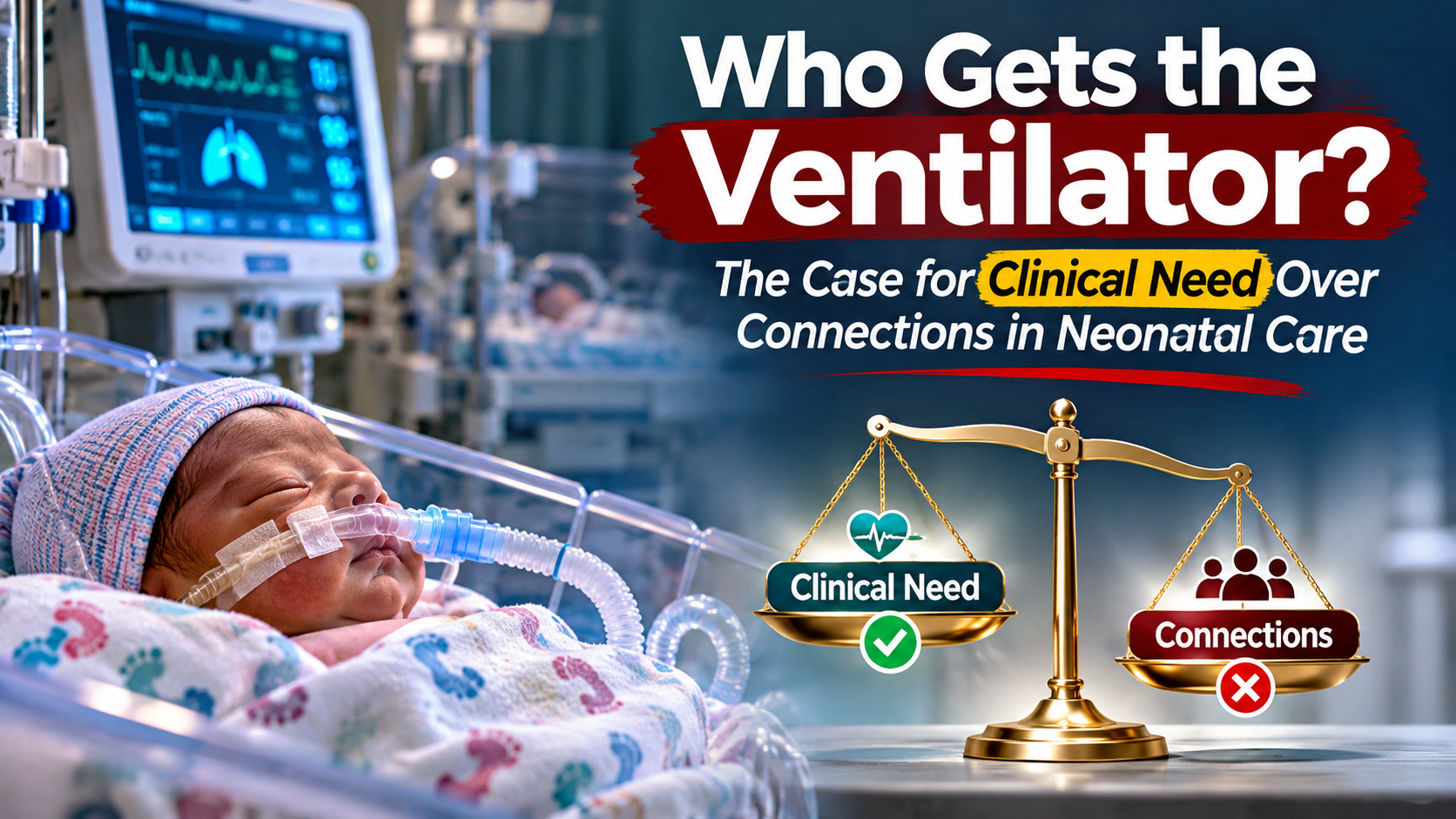
Who Gets the Ventilator? The Ethical Dilemma of Clinical Need Over Personal Connections in Neonatal Care
Scenario
In a public sector pediatric emergency unit, three intubated neonates in the resuscitation area remain ventilator dependent. Unit protocol requires transfer to step-down care once stable, but all three still need ventilation. The NICU has only two functional ventilators, both in use. An internal review found that two previously admitted neonates gained ventilator access through personal connections rather than clinical need a known but informal practice. No formal triage or resource allocation policy exists. Despite continuous manual ventilation by nursing staff, one neonate died due to ventilator unavailability. This is not an isolated incident but a daily reality in Pakistan’s public healthcare system, where scarcity is nationwide.
Those with social connections and financial stability secure life-saving allocations, while those without relying on an overburdened system that cannot serve them equitably. This inequity persists because no formal framework exists to identify and prioritize the greatest clinical needs. Consequently, frontline nurses experience profound moral distress a systemic workforce issue that remains largely unaddressed. I argue this practice is ethically indefensible, violating justice, non-maleficence, and fidelity. A fair, transparent allocation protocol grounded in Principlism and Distributive Justice is required to maximize survival and restore trust in public sector healthcare.
Ethical Analysis: A Proper Triage System Over Informal Allocation
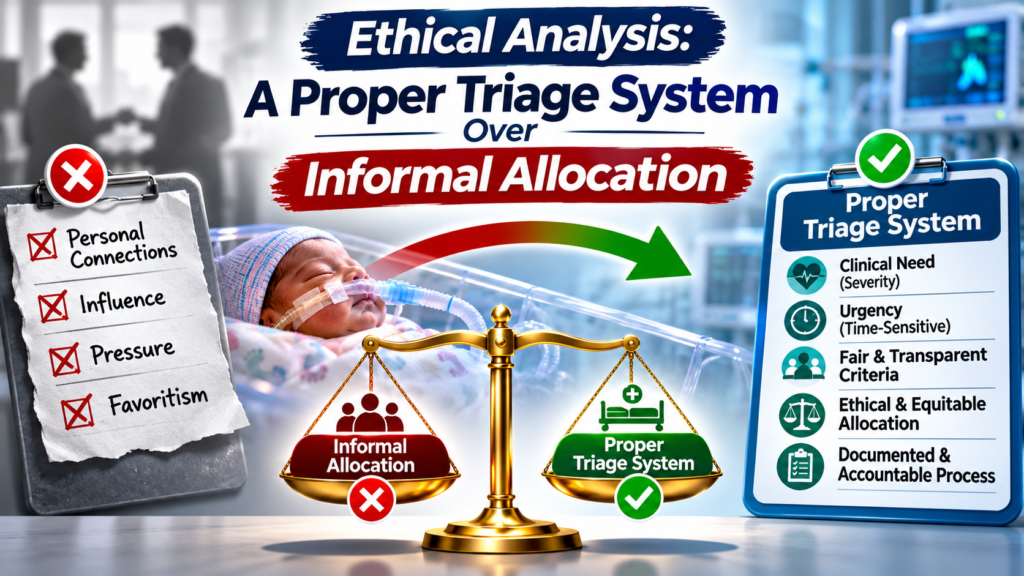
Informal allocation violates justice. Justice demands that scarce resources be distributed according to clinical need rather than social advantage (Maslen & Paine, 2024). When ventilators are allocated through personal connections, the sickest neonates those without social capital are systematically disadvantaged. Timmer (2024) argues that justice requires equal access to adequate health and that resources should benefit those who lack this threshold. In the neonatal unit, the absence of a formal triage protocol means the threshold is set by social capital, not clinical need for a direct violation of distributive justice.
Informal allocation also violates non-maleficence. Non-maleficence obligates providers to avoid causing harm. When a neonate dies because a ventilator went to another infant based on connections rather than clinical urgency, the system has directly contributed to preventable harm. Srinivas et al. (2021) state that when rationing is unethical, “the victim would be losing nothing but their life.” This is the exact harm in the neonatal unit: death caused not by clinical futility but by systemic injustice.
The absence of a formal triage protocol violates fidelity. Fidelity obligates institutions to honor their implicit promise of equitable care (Masters, 2014). Public sector hospitals exist to serve those who cannot afford private care; when access depends on connections rather than need, that promise is broken. Srinivas et al. (2021) identify transparency, inclusiveness, consistency, and accountability as pillars of fair rationing all absent when allocation rests on sifarish.
Informal allocation further violates distributive justice. Daniels (2001), Wiles & Pease (2013) articulated Walzer’s principle, distributive justice demands that resources benefit the least advantaged. Mabaquiao (2021) shows that allocation must balance welfare maximization with fair equality of opportunity. Informal ventilator allocation fails on both counts: it does not maximize survival, nor does it protect the fair opportunity of the most vulnerable neonates. Wilmot-Smith (2019) argues that justice requires equal access to life-saving resources and that arbitrary factors like social connections should not determine outcomes.
Counterarguments: Relational Duty and Cultural Relativism
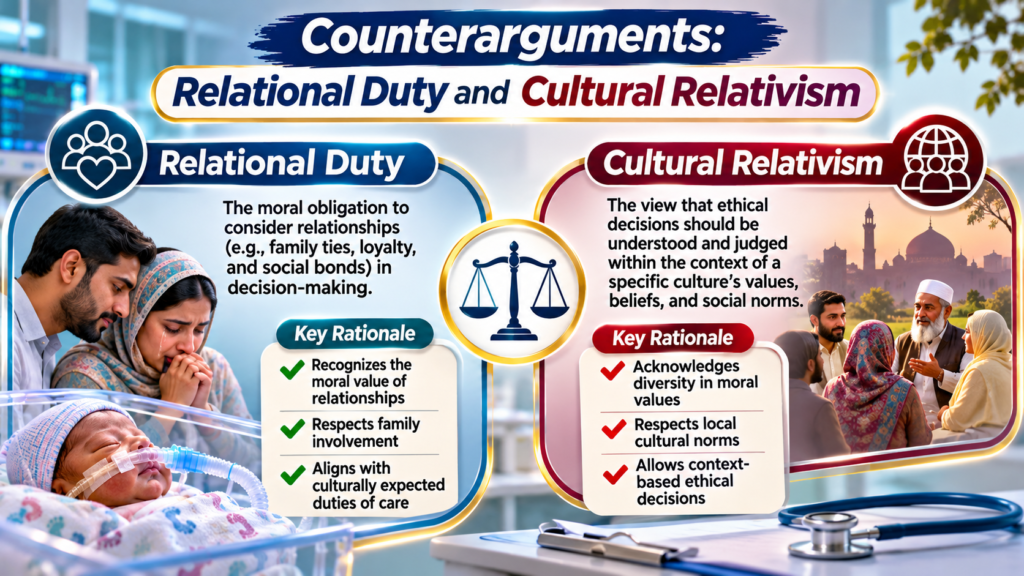
One might argue that families using personal connections act within the ethics of care, fulfilling a relational duty to protect their own child. Hordern (2021) demonstrates that non-public reasoning, including familial and cultural values, has a legitimate role in healthcare deliberation. Where formal systems seem unreliable, using connections may be a rational survival strategy rather than an ethical failing. Further, one might contend that using personal connections is a culturally embedded practice.
Hordern (2021) argues that public reason is indeterminate on many healthcare matters and that cultural reasoning cannot be excluded from deliberation. Srinivas et al. (2021) support this, noting that rationing guidelines must be country-specific. From this perspective, sifarish is not a moral violation but a rational response to systemic failure. These counterarguments draw on Care Ethics (Noddings), which prioritizes relationships and context over abstract rules, and Cultural Relativism, which holds that ethical judgements are context-dependent and cannot be universalized.
Ethical Justification for My Position
The ethics of care rightly recognizes that parents have a profound moral obligation to their own child, and their actions are motivated by love, not malice. However, this argument has a critical limitation: it ignores the duties of healthcare institutions and professionals. Care Ethics does not operate in a vacuum; it must be balanced against justice and non-maleficence. If every family used connections to secure scarce resources, the system would collapse, and the most vulnerable those without connections would be systematically denied care. A parent’s love for their own child cannot justify a system that kills other people’s children.
Similarly, cultural relativism rightly cautions against imposing external moral standards on local practices, but it cannot distinguish between harmless and harmful practices. Just because sifarish is normalized does not make it ethical. Child marriage and corruption are also cultural practices, but that does not make them morally acceptable. The fact that sifarish is common in Pakistani public hospitals does not justify its continuation, especially when it results in preventable deaths.
Wilmot-Smith (2019) argues that justice requires equal access to life-saving resources and that arbitrary factors like social connections should not determine outcomes. Timmer (2024) further demonstrates that justice demands equal access to adequate health a threshold violated when ventilators are allocated by sifarish rather than clinical need. Srinivas et al. (2021) argue that wealth and personal connections should never determine access to medical services. Andreswari et al. (2026) provide empirical evidence that informal allocation leads to disparities, and Munthe et al. (2021) demonstrate that such practices erode trust in the healthcare system.
Therefore, while parental partiality and cultural norms are understandable, they cannot override the institutional obligation to allocate resources fairly. A formal, transparent triage protocol grounded in justice and non-maleficence is ethically required.
Possible Consequences
The consequences of adopting a formal triage protocol are profound. If ventilators are allocated by clinical need rather than social connections, the sickest neonates regardless of social capital will have a fair chance of survival. Timmer (2024) argues that justice requires equal access to adequate health, and a formal protocol would uphold this principle. Families will trust that decisions are fair, even when heartbreaking. Nurses will experience reduced moral distress, no longer witnessing preventable deaths caused by sifarish. Public trust will be restored as marginalized families see the system serving them, not just the connected.
Conversely, if informal allocation continues, preventable neonatal deaths will persist. The sickest neonates those without connections will continue to die because ventilators go to those with social capital. Families will lose trust, perceiving the system as cruel and indifferent. Andreswari et al. (2026) provide empirical evidence that disparities in triage outcomes erode trust and raise concerns about distributive and procedural justice.
Nurses will experience intensified moral distress, feeling helpless as they witness injustice. Munthe et al. (2021) demonstrate that such practices deplete future value and erode trust. Public trust will collapse, and the system will become paralyzed, with no one taking responsibility.
These consequences are realistic in the Pakistani context. Public hospitals already face severe resource constraints, and informal allocation is widespread. A formal triage protocol, developed through inclusive deliberation and accountable to the public, is both feasible and necessary.
Recommendation
A standardized triage scoring system should be established. Clinicians would score each neonate objectively based on clinical severity, likelihood of survival, and urgency. Andreswari et al. (2026) demonstrate that formal triage protocols reduce disparities in emergency care.
A Hospital Ethics Committee should be created to oversee ventilator allocation, review contested cases, and audit decisions for fairness. Hordern (2021) discusses Accountability for reasonableness, which requires publicity, relevance, revision, and enforcement.
Transparency and public reporting should be mandated. The hospital should publish aggregate data on allocation of decisions, including outcomes and criteria used. Srinivas et al. (2021) identify transparency and accountability as pillars of fair rationing.
Families with financial resources should be offered referral to private hospitals if their neonate is not the highest priority for a ventilator. This frees public resources for those without alternatives while respecting justice.
The protocol should be piloted in one neonatal unit before scaling up. Andreswari et al. (2026) recommend ongoing monitoring and evaluation, and Munthe et al. (2021) argue for sustainability ensuring the protocol works overtime.
These recommendations are realistic and feasible in the Pakistani context. They do not require eliminating corruption overnight; they create transparent structures that make sifarish harder to practice and easier to detect.
Conclusion
Informal allocation of neonatal ventilators in Pakistan’s public hospitals is not merely a logistical failure it is an ethical failure. It violates justice, non-maleficence, and fidelity, disproportionately harms the most vulnerable, and erodes trust in a system that exists to serve those without alternatives. While parental partiality and cultural norms are understandable, they cannot override the institutional obligation to allocate resources fairly.
A formal, transparent triage protocol grounded in Principlism and Distributive Justice is ethically required. Such a protocol would prioritize clinical need, reduce moral distress among nurses, restore public trust, and ensure that the question “Who gets the ventilator?” is answered not by connections but by clinical need. The time for reform is now; the lives of our most vulnerable depend on it
References
Andreswari, R., Fahrenkrog-Petersen, S. A., & Mendling, J. (2026, May). Fairness in Healthcare Processes: A Quantitative Analysis of Decision Making in Triage. In International Conference on Research Challenges in Information Science (pp. 489-506). Cham: Springer Nature Switzerland.
Daniels N. (2001). Justice, health, and healthcare. The American journal of bioethics : AJOB, 1(2), 2–16. https://doi.org/10.1162/152651601300168834
Hordern, J. (2021). The challenge of healthcare for consensus public reason. Social theory and practice, 485-517.
Mabaquiao Jr, N. M. (2021). Justice in healthcare: Welfare and equal opportunity. Asia-Pacific Social Science Review, 21(1), 16.
Maslen, H., & Paine, C. (2024). Ethical Resource Allocation in Policing: Why Policing Requires a Different Approach from Healthcare. Criminal justice ethics, 43(1), 1–36. https://doi.org/10.1080/0731129X.2024.2327819
Masters, B. R. (2014). Principles of Biomedical Ethics, Eds: Tom L. Beauchamp and James F. Childress Oxford University Press, 2013. XVI, 459 Pages, US $66.95, ISBN-13: 978-0-19-992458-5.
Munthe, C., Fumagalli, D., & Malmqvist, E. (2021). Sustainability principle for the ethics of healthcare resource allocation. Journal of medical ethics, 47(2), 90–97. https://doi.org/10.1136/medethics-2020-106644
Srinivas, G., Maanasa, R., Meenakshi, M., Adaikalam, J. M., Seshayyan, S., & Muthuvel, T. (2021). Ethical rationing of healthcare resources during COVID-19 outbreak: Review. Ethics, medicine, and public health, 16, 100633. https://doi.org/10.1016/j.jemep.2021.100633
Timmer D. (2024). The sufficiency theory of justice and the allocation of health resources. Bioethics, 38(9), 796–802. https://doi.org/10.1111/bioe.13338
Wiles, P., & Pease, K. (2013). Distributive justice and crime. In Crime, Disorder and Community Safety (pp. 219-240). Routledge.
Wilmot-Smith, F. (2019). Equal justice: Fair legal systems in an unfair world. Harvard University Press.
Childress, T. L. B. J. F. principles of biomedical ethics (seventh ed.).
Authors
Tanzeela M. Younus and Safura Hussain
MScN Year 1 Students, School of Nursing and Midwifery, Aga Khan University